Occupational Therapy (OT)
New paediatric OT appointments are currently available at our Croydon clinic
Wondering whether Occupational Therapy could help? Let's make sense of it together.
You might know exactly what you're concerned about. Handwriting is exhausting. Getting dressed takes forever. Your child finds using cutlery tricky. They're constantly bumping into things or avoiding activities that other children enjoy.
Or it might be harder to put your finger on.
Getting through the morning feels like a marathon. Your child holds it together at school and falls apart when they get home. Haircuts, clothing or noisy places are really hard. They want to join in at the playground but their body doesn't always seem to do what they want it to. Everyday tasks seem to take far more effort than you expected.
These can all be reasons to see an Occupational Therapist.
For children and young people, “occupations” are the everyday things they need and want to do — playing, learning, looking after themselves, participating at school, spending time with other people and becoming more independent.
Occupational Therapy helps us understand what's making those everyday activities easier or harder, and what skills, strategies, supports or changes could help.
At Playology, we want to understand what's happening for your child, what matters to them and your family, and what support could make a meaningful difference in everyday life.
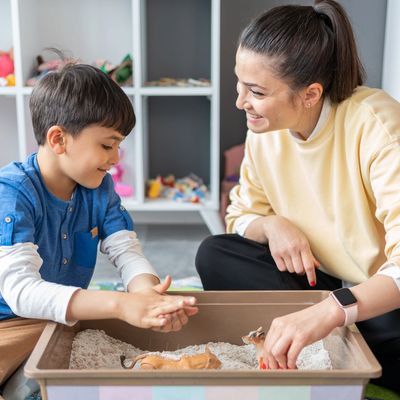
Occupational Therapy appointments currently available
Does any of this sound familiar?
Select any that sound like your child or teen to learn a little more about what might be happening and how Occupational Therapy could help.
Buttons, zips, shoelaces, socks, getting clothes the right way around, tolerating how things feel — there's actually a lot involved in getting dressed.
Some children need help developing the motor skills involved. For others, sensory experiences, planning, attention, sequencing or the number of steps in the task can make getting ready much harder.
Occupational Therapy can help us understand what's making dressing tricky and find ways to build independence or make the task work better for your child and family.
Your child might write slowly, tire quickly, find their writing difficult to read, struggle to keep up with their ideas, avoid written work or become frustrated when there's a lot to get onto the page.
Handwriting involves much more than holding a pencil. Children are coordinating fine motor skills, visual information, posture, attention, planning and the demands of the task all at once.
An Occupational Therapist can help work out what's contributing and whether building particular skills, changing the task, using different tools or introducing alternative ways of completing written work would be useful.
The goal isn't necessarily beautiful handwriting. It's helping your child get their ideas onto the page in a way that works for them.
Some children seem to seek movement throughout their day.
They might crash into cushions, climb everything, move constantly in their chair, play roughly, chew things, seek big hugs or seem to need much more movement than the people around them.
Rather than simply trying to stop the behaviour, Occupational Therapy can help us understand what your child may be getting from these experiences and how we can support their body in ways that are safe and useful.
Children experience sensory information differently.
Sounds, touch, movement, smells, lights, food textures or the feeling of clothing can be barely noticeable to one child and overwhelming to another.
Occupational Therapy can help children and families understand their sensory experiences, recognise what helps and find practical ways to make everyday environments and activities more manageable.
The aim isn't to make a child tolerate discomfort for the sake of appearing okay. It's to help them understand their needs, access what supports them and participate in the things that matter to them.
Running, catching, climbing, riding a bike, using playground equipment, learning a new movement or keeping up in sport can take a lot of coordination.
Some children avoid these activities. Others enthusiastically join in but find them much harder than their peers.
Occupational Therapy can help develop coordination, balance, body awareness, motor planning and confidence with movement, while finding activities that are meaningful and motivating for your child.
Cutting with scissors. Using cutlery. Opening containers. Doing up buttons. Building with small pieces. Drawing. Using classroom tools.
These activities rely on fine motor skills, coordination between the hands, visual-motor skills and planning.
Occupational Therapy can help children develop the skills they use with their hands and find practical ways to make everyday tasks more accessible.
Some children understand the task perfectly but find starting, organising or working through it much harder.
Getting ready for school, packing a bag, starting homework, cleaning a room or completing a multi-step task can become overwhelming very quickly.
Occupational Therapy can help children and families break tasks down, find systems that work for the individual child, and develop strategies for planning, organising and getting things done.
A child can look as though they're managing beautifully while using an enormous amount of energy to get through the day.
School involves learning, movement, noise, transitions, social interactions, instructions, sitting, waiting, organising belongings and constantly responding to what's happening around them.
By the time a child gets home, there may not be much capacity left.
Occupational Therapy can help us look at the demands across the whole day, understand where your child's energy is going and find ways to support participation without expecting them to simply push through.
Brushing teeth. Leaving the house. Getting into the shower. Sitting at the table. Packing a school bag. Going somewhere unfamiliar.
Sometimes an everyday activity becomes so difficult that the whole family begins organising around it.
An Occupational Therapist can help unpack what's making the activity difficult, identify the skills or demands involved and work with your family on practical ways to make it more manageable.
As children get older, the things they want and need to manage independently change.
That might mean preparing food, organising schoolwork, managing belongings, using public transport, handling money, planning their time, navigating the community or taking more responsibility for their own routines.
Occupational Therapy can help children and young people build practical skills and find strategies and supports that increase independence in the areas that matter to them.
The goal isn't independence at all costs. It's having more choice, confidence and control over everyday life.
Why Occupational Therapy (OT) at Playology?
Support that actually fits your child
Sometimes the concern is straightforward. Your child might want help learning to tie their shoelaces, improve a particular motor skill or find a more comfortable way to manage handwriting — and that's exactly what we'll work on.
Other times, the activity you're seeing can be difficult for several different reasons.
A child struggling to get dressed might need help with buttons and fasteners. They might find the sensation of particular clothing uncomfortable. Remembering the sequence might be hard. Or getting dressed might be one more demand in an already overwhelming morning.
Understanding what's happening helps us choose support that actually fits your child.
Sometimes that means directly developing a skill. Sometimes it's changing the task, adapting the environment, introducing equipment or tools, developing a strategy, or helping the important people around your child understand what works for them.
We want therapy to have a purpose — not to change who your child is, but to give them skills, strategies and supports that make a meaningful difference in everyday life.
And when the bigger picture matters, we have a bigger team.
Our OTs work alongside Playology's Psychologists and Speech Pathologists.
This is important because participation in everyday life can overlap with things like communication, learning, attention, emotions, sensory experiences and development. When it does, we don't have to look at each piece separately. Our clinicians can share ideas and think together when that's helpful, giving your Occupational Therapist a broader understanding of what's happening for your child.
That doesn't necessarily mean adding another therapy.
Your Occupational Therapist might consult behind the scenes with one of our Psychologists or Speech Pathologists and bring ideas or strategies back into your child's existing sessions. They might suggest a one-off consultation to explore a particular question, or recommend pausing or shifting the focus of therapy while something else is supported first.
And if your child already has other therapists who know them well, we want to work with them too. Having Psychology and Speech Pathology at Playology doesn't mean you need to use ours. We're happy to connect and collaborate with your child's existing team, school or kinder, or help you find another service when that's the better fit.
Sometimes Occupational Therapy is exactly the right focus on its own. Sometimes another perspective helps us get more from the work we're already doing.
For your family, having different perspectives available means support with a clear purpose — making the best use of your child's time, your time and your therapy budget, and focusing on what is most likely to make a meaningful difference.
Occupational Therapy (OT) Assessments

Occupational Therapy assessment can help build a clearer picture of how your child manages everyday activities, where things come easily, where they take more effort, and what supports might be useful.
Depending on your questions, assessment might explore areas such as fine motor skills, visual-motor skills, handwriting, coordination, sensory processing, self-care and everyday functioning.
You don't need to know which assessment to ask for. Tell us what you're noticing and we'll help work out what information would actually be useful.
Focused Occupational Therapy Assessments
Focused Occupational Therapy Assessments
Focused Occupational Therapy Assessments
Sometimes there's a specific question to answer.
That might be:
- What's making handwriting so effortful?
- Why are dressing or other self-care tasks difficult?
- How is my child experiencing sensory information?
- What's contributing to difficulties with coordination or movement?
- What might help my child participate more easily at school?
- What supports could increase independence at home or in the community?
Assessment can help identify what's contributing, what your child's strengths are and what practical supports or strategies could make a difference.
Functional Capacity Assessments
Focused Occupational Therapy Assessments
Focused Occupational Therapy Assessments
A Functional Capacity Assessment looks at how your child manages everyday activities, participation, independence, strengths and support needs across home, school and the community.
Depending on your child, this might include things like self-care, routines, sensory experiences, motor skills, school participation and getting out and about in the community.
These assessments can help families better understand their child's everyday functioning and may also be needed for funding purposes, including NDIS planning or review.
Our Occupational Therapists bring together assessment, observation and information from the people who know your child to provide a clear picture of what's working well, where support is needed and recommendations that make sense for everyday life.
Multidisciplinary Assessments
Focused Occupational Therapy Assessments
Multidisciplinary Assessments
Sometimes Occupational Therapy is one part of a broader developmental question.
Our Occupational Therapists can work alongside Playology's Psychologists and Speech Pathologists when different perspectives would help us understand the whole picture.
Rather than automatically completing separate assessment processes that repeat the same background information, where appropriate our clinicians can coordinate what they're assessing, share relevant information and bring their findings together.
This might be useful when there are questions across areas such as development, learning, communication, sensory experiences, motor skills or everyday functioning.
For families, coordinated assessment can mean less duplication, fewer appointments spent repeating the same information, and clearer recommendations about how the different pieces fit together.
Occupational Therapy (OT) Support
Occupational Therapy (OT) doesn't have to look the same for every child.
You might be ready to get started, have one particular question you'd like help with, or be looking for opportunities for your child to practise skills in everyday situations.
Getting Started
You don't need to know exactly what kind of Occupational Therapy support your child needs before you get started. We'll work that out with you.
Your first appointment is a parent intake. This gives you space to talk with your Occupational Therapist about what you've noticed, what's important to your child and family, what's already working, what you've tried, and what you're hoping OT might help with.
From there, we'll work out what makes sense.
That might include direct sessions with your child, parent sessions, practical strategies for home or school, assessment, changes to the environment, equipment or supports, collaboration with other people in your child's life, or a combination.
The aim isn't therapy for therapy's sake. It's working out what will actually be useful in your child's everyday life.
Parent Sessions
Sometimes the most useful OT work happens with parents rather than directly with your child.
Parent sessions give you space to step back from an everyday challenge and work out what's making it hard. That might be getting out the door in the morning, dressing, mealtimes, sleep routines, sensory experiences, homework or managing transitions.
Your Occupational Therapist can help you look at the task, the environment and what your child needs to participate, then find practical ways to make things work better — whether that's changing the setup, reducing demands, introducing supports or developing strategies together.
Your child doesn't always need to attend for Occupational Therapy to make a difference in their everyday life.
One-off Problem Solving Sessions
Sometimes you're not looking to start regular Occupational Therapy. You just have something you'd like help thinking through.
Our Problem Solving Sessions are longer, one-off appointments where parents can explore a particular question or challenge with an Occupational Therapist.
You might want help with a morning or bedtime routine, dressing, sensory experiences, school participation, independence, handwriting, or another everyday activity that's become difficult.
Your Occupational Therapist can help you unpack what's happening, identify practical strategies to try and work out whether anything else would be useful.
There's no expectation of ongoing appointments afterwards.
Group Therapy
Sometimes the best place to practise a skill is while actually doing something with other children.
Our group programs give children and young people opportunities to use skills in meaningful activities alongside peers. Depending on the group, that might involve cooking, creating, playing games, completing challenges, working as a team or navigating everyday tasks.
Groups can provide opportunities to practise things like planning, coordination, fine motor skills, independence, flexibility, communication, problem-solving and working alongside other people in a supported environment.
Groups aren't a replacement for individual therapy and aren't the right fit for every child. They can be a useful extension of therapy goals, giving children opportunities to use skills in situations that can be difficult to recreate in a one-to-one appointment.
Our Occupational Therapists may run groups independently or alongside Speech Pathologists, Psychologists or Therapy Assistants depending on the program.
Group programs are offered throughout the year for different ages and goals.
“I'm still not sure if OT is what we need.”
That's okay. You don't need to know before you contact us.
You might have a really specific question:
“Why is handwriting so exhausting?”
Or you might simply be noticing that some everyday activities take a lot of effort for your child and wondering whether there's anything that could help.
Both are good places to start.
Tell us what you're noticing. We can help you work out what comes next.
Book an OT Appointment
Playology provides paediatric Occupational Therapy for children and young people from our clinic in Croydon, Melbourne's outer east, with telehealth available where appropriate.
New OT appointments are currently available, including assessment and ongoing support.
Families can contact us directly. A referral isn't required for private or NDIS-funded OT appointments.
Book online or contact our Client Care Team on (03) 9752 1571.
If you require immediate psychological support, the below services are available
EMERGENCY SUPPORT:
Call 000 for emergency support
Lifeline: 13 11 14 or visit www.lifeline.org.au
Kids Helpline: 1800 551 800 or visit www.kidshelpline.com.au
Playology acknowledges the Traditional Owners of the land where we work and live. We pay our respects to Elders past, present and emerging. We celebrate the stories, culture and traditions of Aboriginal and Torres Strait Islander Elders of all communities who also work and live on this land.
ACN: 669 058 146 / ABN: 77 669 058 146
Copyright © 2023 Playology Clinic
This website uses cookies.
We use cookies to analyse website traffic and optimize your website experience. By accepting our use of cookies, your data will be aggregated with all other user data.